

Quick answer: Post Reels Tuesday to Thursday, in your audience's local time. Buffer's 2026 study of 9.6 million posts found evenings (6–11 PM) strongest for Reels, with Wednesday and Thursday the best days; Sprout Social's 2026 data puts the midweek peak at 12–7 PM. Avoid 1–5 AM and Friday–Saturday. In India, read the same times as IST.
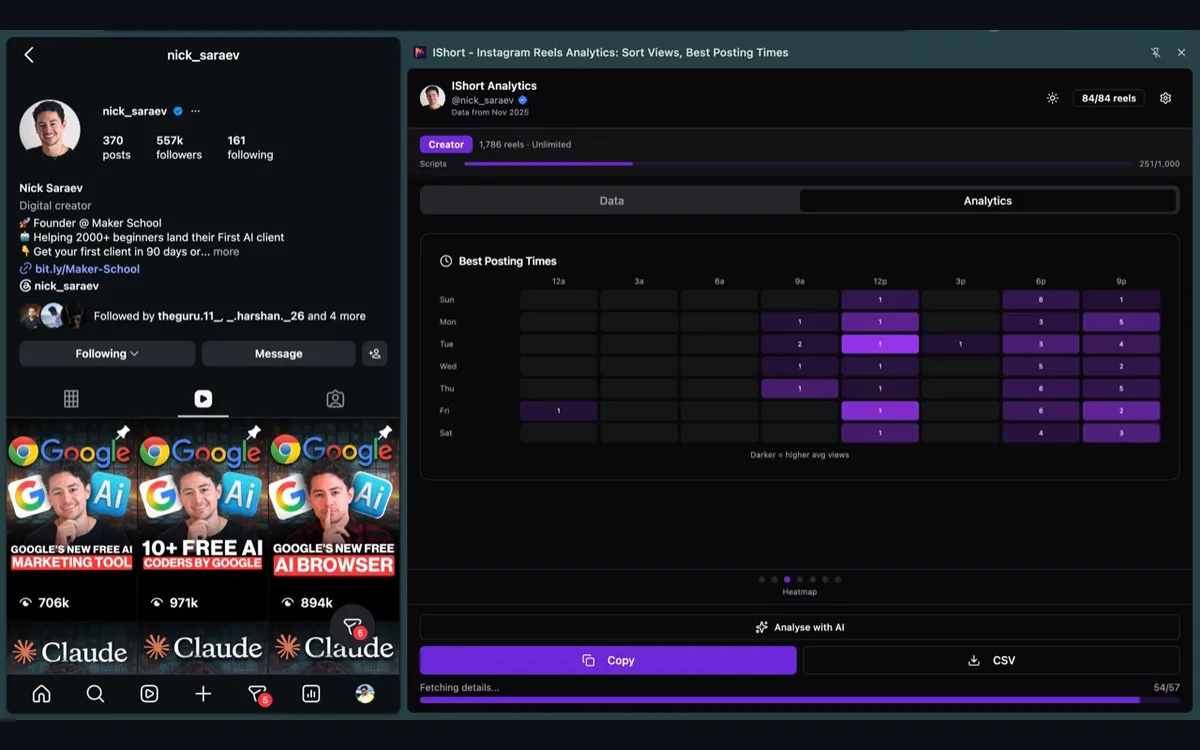
Check your own: these are averages. IShort, a free Chrome extension, builds a day-by-hour heatmap of when your Reels (or any public account's) got the most views.
| Day | Buffer 2026: best times | Sprout Social 2026: peak |
|---|---|---|
| Monday | 7 PM (or 6, 8 PM) | 2–4 PM |
| Tuesday | 7 PM (or 3, 5 PM) | 1–7 PM |
| Wednesday Best | 12 PM (or 6 PM, 8 AM) | 12–9 PM |
| Thursday Best | 9 AM (or 8, 7 AM) | 12–2 PM |
| Friday | 10 PM (or 9 PM); weak day | No clear peak |
| Saturday | 9 PM (or 10, 8 PM); weakest | Lowest of the week |
| Sunday | 9 PM (or 10, 8 PM) | Weak |
Audience local time (IST, EST or any other). Sources: Buffer, 9.6M Instagram posts, Jan 2024–Dec 2025; Sprout Social, ~2B engagements on 307k profiles, Nov 2025–Feb 2026. Both pool all post types, not Reels only.
Get your own posting-time heatmap in 2 minutes
Instagram Insights shows when your followers are online, not when your Reels actually got views, and it needs a public account. IShort maps each published Reel to its performance instead:
- Install IShort from the Chrome Web Store (free).
- Open instagram.com/yourname/reels/ (or a competitor's) and let IShort collect the Reels as you scroll.
- In the IShort side panel, swipe to the posting-time heatmap. Darker cells = the day and hour when those Reels averaged the most views.
Get your free posting-time heatmap
Where these times come from: Buffer's State of Social Engagement 2026 (9.6 million Instagram posts, Jan 2024–Dec 2025) and Sprout Social's 2026 analysis (nearly 2 billion engagements across 307,000 profiles, Nov 2025–Feb 2026). They are cross-niche averages: use IShort's heatmap on your own account and your competitors' to find your niche's slot.
How posting time actually affects Reels distribution in 2026
Adam Mosseri has named watch time, likes and sends (people sharing your Reel by DM) as the signals that matter most for ranking. All three depend on your followers being awake, scrolling and likely to share, which is why posting time still matters.
Instagram's recommendation system is a chain reaction. Your first 30–60 minutes of engagement determine whether the algorithm decides this Reel is worth pushing into the feeds of non-followers. In Buffer's 2026 data the gap between the best slots and the lulls is "more of a chasm than a crevice", and Adam Mosseri suggests posting 30 to 60 minutes before your audience usually comes online.
For deeper algorithm context, see our Instagram Reels algorithm 2026 guide. The short version: timing isn't a vanity metric, it's a multiplier on every signal the ranker reads.
Why "send-per-DM" makes timing matter more
In Mosseri's @creators updates throughout 2025, he repeatedly highlighted that the strongest signal a Reel is worth promoting is people sending it to a friend in DMs. Sends only happen when both parties are awake and active. Posting at 3 AM local means no one's around to share to anyone — the Reel cools off before it gets the social proof boost it needs.
Best times to post Reels by day of the week (2026)
The table at the top of this page puts Buffer's and Sprout Social's 2026 studies side by side. Where they agree:
- Midweek wins. Buffer ranks Wednesday first, then Thursday and Tuesday. Sprout Social's highest peaks are Tuesday and Wednesday.
- Evenings beat mornings for Reels, except on Thursday. Buffer found 6–11 PM strongest on every weekday but Thursday, when 7–9 AM leads. Sprout's windows sit earlier, from lunch to early evening.
- The weekend is weak. Friday and Saturday are Buffer's two worst days, and Sprout calls weekends the lowest across almost all industries. If you post on a weekend, Buffer's best slot is Sunday 8–10 PM.
- Overnight is dead. 1–5 AM had the lowest engagement every day in Buffer's data; Sprout flags 3–7 AM.
Where they differ (evening vs afternoon), test both: post one Reel at 7 PM and one at 1 PM in the same week, then compare them in your heatmap. Trial Reels make this easier; see how to A/B test Reels with Trial Reels.
Best time to post Reels in India (IST breakdown)
Buffer says its times apply in your own time zone, IST included, so for an Indian audience the table above reads as IST: weekday evenings first, midweek strongest. The windows below are starting points for Indian audiences to test, not measured results:
| IST Window | Behavior context | Best for |
|---|---|---|
| 7:00–9:00 AM IST | Morning commute, breakfast scroll | Educational, news, motivational |
| 12:00–2:00 PM IST | Office lunch break, college breaks | Food, comedy, quick tips |
| 6:00–8:00 PM IST | Commute home, early evening | Entertainment, fashion, lifestyle |
| 8:00–11:00 PM IST Peak | Post-dinner scroll, family time | Everything — especially Hindi content |
Hindi vs English Indian audiences
If your captions and audio are primarily in Hindi, push your posting toward 9–11 PM IST. Hindi-first audiences over-index on the late-evening slot — this is when family viewing collapses around the same phone, and shares happen most. English-first Indian audiences (urban, often professional) skew toward the 7–9 AM commute slot and 9–10 PM.
Tier-1 vs Tier-2/3 city patterns
Tier-1 metro audiences (Mumbai, Delhi, Bengaluru) follow the office-day schedule above closely. Tier-2/3 audiences in markets like Lucknow, Kanpur, Indore, and Coimbatore peak later — engagement holds strong all the way to 11:30 PM IST, since work and family schedules run later. If your analytics shows >40% Tier-2/3 audience, push your evening Reel to 9 PM IST or later.
Time-zone math for non-Indian creators targeting India
If you're posting from the US and your audience is Indian, you have to flip your schedule. 9 PM IST = 11:30 AM ET / 8:30 AM PT during US daylight time (an hour earlier in winter). That's why a US-based creator posting at "their" 9 PM completely misses the Indian peak. Instagram Insights shows your followers' top locations, and IShort's heatmap shows the day and hour your Reels actually got views, so you can check the switch worked.
Best times to post Reels by niche
Starting points by niche to test against your own heatmap, not measured results.
Food & restaurants
Food Reels are governed by hunger. Peak windows: 11:30 AM–1:30 PM (lunch inspiration), 5:30–7:30 PM (dinner ideas), and Sunday morning 9–11 AM (weekly meal planning). Recipe and short cooking demos perform especially well in the lunch window because viewers are deciding what to order or cook in real time. Indian food creators should add the 9–11 PM IST slot — late dinners drive massive saves.
Fitness & wellness
Fitness audiences are bimodal. Strong peaks at 5–7 AM (pre-workout planning) and 6–8 PM (post-work motivation). Sunday morning is the strongest single slot of the week for fitness Reels because viewers are setting weekly intentions. In India, add a 10 PM IST peak for home-workout content — many Indian users train late after dinner.
Fashion & beauty
Fashion content peaks 11 AM–2 PM on weekdays (lunch-break browse) and 1–3 PM on weekends. Wednesday is a sleeper-hit day for fashion Reels — mid-week outfit-of-the-day content gets the best engagement. Beauty tutorials hit hardest 8–10 PM as users wind down.
Finance & business
Finance Reels (personal finance, stocks, crypto, business tips) skew weekday-only. Peak: 8–10 AM commute and 5–7 PM evening commute, Tuesday through Thursday. Weekends are quiet — people don't want to think about money on Saturdays. Indian finance creators get a strong bonus peak 9 AM IST when markets open and 4 PM IST at market close.
Entertainment, comedy, and meme accounts
Entertainment plays by different rules. Peak: 7–10 PM weekdays, 12–3 PM Saturday, and 8–11 PM Sunday. Meme accounts can also exploit the 11 PM–1 AM insomnia slot — engagement is low volume but extremely high per-viewer. In India, comedy in regional languages (Tamil, Telugu, Marathi) peaks 10–11:30 PM IST.
How often should you post Reels in 2026?
Hopper HQ's posting-frequency guide recommends 2 to 4 Reels per week, alongside 3–5 feed posts and near-daily Stories. Below 2 Reels/week and you lose algorithmic momentum — the Reels tab forgets you. Above 4–5 Reels/week without a production team and you start cannibalizing your own reach: each Reel splits the same audience attention.
Posting cadence interacts with timing in a predictable way:
- 2 Reels/week: Tuesday 7 PM + Wednesday 6 PM. Both in Buffer's peak windows.
- 3 Reels/week: Tuesday 7 PM + Wednesday 12 PM + Thursday 9 AM. Adds the lunch and morning audience.
- 4 Reels/week: Add Sunday 9 PM, the strongest weekend slot in Buffer's data.
- 5+ Reels/week: Only worth it if you have multiple content pillars (e.g., recipe + behind-the-scenes + tip + customer story). Otherwise, double down on quality. See our Reels scheduling and planning guide for batch-shoot workflows.
One nuance for accounts under 10K followers: posting at slightly off-peak times (think Tuesday 5 PM instead of Tuesday 7 PM) can outperform peak posting because there's less competition for the algorithm's first-impression slots. Test ±90 minutes around the table values — the optimal point shifts by audience.
How to find YOUR audience's best time
The numbers above are a starting point. To check another account, try the free best time to post checker for any Instagram account. Your real best-time depends on your follower mix, time zones, and content type. Two ways to find it:
Method 1: Instagram's built-in Insights (free, limited)
- Open your profile and tap Professional dashboard (Your dashboard on a personal account), then your insights.
- Scroll to Total followers and tap it.
- Scroll down to Most active times. It has Hours and Days tabs.
- The chart shows when your followers are online, not when they engage.
Limitation: Instagram only shows you when followers are active, not when your past Reels actually got engagement. That requires a tool that maps published-time to performance.
Method 2: IShort heatmap (covers your actual performance)
The IShort Chrome extension reads every Reel you've published, joins it to its views, likes and comments, and renders a 7×24 heatmap of your real performance. Steps:
- Install IShort from the Chrome Web Store (free).
- Visit your Instagram profile's Reels tab and scroll to load history.
- Open IShort, switch to the Analytics view, scroll to the posting heatmap.
- Hot cells = hours/days your Reels actually outperformed your average.
See the heatmap and its 3-step setup at the top of this page.
You can also use this against competitors. Our find top-performing Reels guide walks through using IShort to see when competitor Reels in your niche peak, then test those slots yourself.
Get your own posting heatmap in 2 minutes
Generic best-times are the median. Your audience is not the median. Install IShort to see exactly which hour of which day each of your Reels actually performed best — and which hours your past Reels died.
Install IShort — Free Forever5 common posting-time mistakes
- Posting in your time zone, not your audience's. Most fatal mistake. A creator in Toronto with an Indian audience posting at 9 PM ET (7:30 AM IST next day) misses the entire Indian evening peak.
- Optimizing for activity instead of engagement. Followers being "online" means they're scrolling, not necessarily engaging. Mosseri suggests posting 30–60 minutes before your followers' peak online hour, so the Reel is fresh when they arrive.
- Treating peak time as a single number. There are 2–3 daily peaks, not one. Posting all 4 weekly Reels at "Tuesday 7 PM" cannibalizes your own reach.
- Ignoring weekly seasonality. Friday and Saturday are the two weakest days in Buffer's 2026 data — saving big launches for Friday afternoon is a common own-goal.
- Never re-checking. Your audience changes as you grow. The best time you found six months ago might be wrong today, especially if your audience-language mix or country mix shifted. Re-run your heatmap quarterly. See our free Reels analytics guide for a quarterly check workflow.
Cross-platform context: how Reels timing compares to TikTok and YouTube Shorts
If you're posting the same content to multiple platforms, you can't reuse the same schedule. Audiences on TikTok and YouTube Shorts keep their own hours, so check each platform's analytics separately. Most creators end up with one schedule per platform — not one schedule applied everywhere.
Instagram Reel Post Times
The quick answer on Instagram Reel post times in 2026: weekday evenings, 6–11 PM in your audience's local time, with Wednesday and Thursday the strongest days (Buffer). Sprout Social's data puts the midweek peak earlier, 12–7 PM. Avoid 1–5 AM, when engagement bottoms out every day.
For weekend posting, Buffer's best slot is Sunday 8–10 PM; Saturday is its weakest day. If your audience is in multiple time zones, layer two daily slots — one for the eastern audience peak, one for the western — rather than picking a single compromise time that misses both.
One critical caveat: these Reel post times are a starting point, not a fixed rule. Run your own analytics quarterly to see which exact slots work for YOUR audience. Build your custom posting heatmap with IShort.
Frequently asked questions
What is the best time to post Reels?
Tuesday to Thursday, in your audience's local time. Buffer's 2026 study of 9.6 million posts found evenings, 6 to 11 PM, strongest for Reels, with Wednesday and Thursday the best days. Sprout Social's 2026 data puts the midweek peak at 12 to 7 PM. Test both, then check your own heatmap.
What is the best time to post Reels in India (IST)?
Use the same local-time windows in IST: weekday evenings, 6 to 11 PM IST, midweek first. Buffer says its times apply in your own time zone, IST included. If your audience is in India but you live elsewhere, convert: 9 PM IST is 11:30 AM in New York during US daylight time.
Should I post Reels every day?
Not unless each Reel is genuinely different. Hopper HQ recommends 2 to 4 Reels a week. Daily posting splits the same audience's attention across more Reels, so start with a steady midweek cadence and add more only if views per Reel hold.
Is it bad to post Reels at 3 AM?
Usually, yes. Overnight, 1 to 5 AM, had the lowest engagement on every day of the week in Buffer's 2026 data. Instagram doesn't penalize the hour itself; few people are awake to watch, like or send the Reel in its first hour.
Does posting time still matter with the 2026 algorithm?
Yes, but less than the content. Adam Mosseri names watch time, likes and sends as the signals that matter most, and all three need your audience awake. Post in a strong window, but timing won't save a weak Reel.
Bottom line: Start with Tuesday and Wednesday evenings (6–11 PM) or Thursday morning (7–9 AM) in your audience's time zone; for an Indian audience, read them as IST. Then test ±90 minutes around those windows for two weeks each, and let your own heatmap take over. Generic times get you to page 1 of decent posting; your own data gets you to viral.
Sources
- Best Time to Post on Instagram in 2026: Data from 9.6 Million Posts — Buffer (Sep 23, 2026)
- Best times to post on Instagram in 2026 — Sprout Social (Mar 31, 2026)
- How Often Should You Post on Instagram in 2026? — Hopper HQ (2–4 Reels a week)
- View account and content insights on Instagram — Instagram Help Center (public personal or professional account)